


Author’s Note
This article reflects my observations and professional opinion after more than thirty years working in photography, digital imaging, and marketing. Where I reference published research, I’ve cited the source. Where I discuss ethics, trust, or professional judgment, those sections represent my own conclusions based on experience. My goal isn’t to argue against AI—I use and teach AI every day—but to encourage thoughtful discussion about how we represent reality in an age when creating synthetic imagery has never been easier.
Artificial intelligence has opened incredible new creative possibilities. As someone who teaches businesses how to use AI responsibly, I’m excited by many of those opportunities. But there’s one trend I can’t ignore. Businesses are increasingly using AI to create “photographs” that never actually existed. Not illustrations, not concept art, and not obviously computer-generated imagery. These are images designed to look like authentic photographs of real people, real places, and real moments—even when none of it ever happened. And I think it’s time we have a conversation about it.
When does a photograph stop being a photograph?
This isn’t coming from someone who fears new technology. I’ve spent more than three decades behind cameras, in darkrooms, in front of computer monitors, and behind the scenes of major events where accuracy mattered.
I’ve lived through:
- Film photography
- Darkrooms
- Digital photography
- Photoshop
- And now… generative AI
Along the way, I worked as a professional color corrector for Getty Images on multiple entertainment events, including Academy Awards red carpet photography. One of my responsibilities wasn’t making celebrities look better. It was making the photographs look more accurate.
The red carpet naturally cast red light onto clothing. Different camera manufacturers produced different color casts. Our job was to ensure the final photographs reflected what people actually saw in real life. The colors of the dresses and clothing were critically important, and standing on a red carpet can alter the colors of the clothing in the photos. Our job just wasn’t manipulation; it was documentary correction for journalism. There is a critical difference.
There Is a Difference Between Enhancement and Fabrication
Before we go any further, I’d like to define the scope of this discussion. I’m talking specifically about images that depict people, places, businesses, interiors, landscapes, events, or objects that viewers are likely to interpret as photographs of the real world. This isn’t a discussion about charts, infographics, logos, icons, technical illustrations, or other graphics designed to communicate information rather than document reality. My focus is on images that carry the visual language—and the implied credibility—of photography.
| Image Type | Ethical Considerations | Representation | Authenticity Expectation |
| Documentary Photography (news, wildlife, historical, evidence) | Minimal edits only; should not alter the facts | Direct record of reality | Very High |
| Enhanced Photography (color correction, exposure, cropping, minor retouching) | Generally acceptable when edits don’t change the subject or meaning | Enhanced photograph | High |
| Commercial & Stock Photography | Acceptable when not presented as documenting a specific event or experience | Staged or representative photograph | Moderate |
| Creative Composites & AI-Assisted Images | Acceptable when presented as artistic or illustrative work | Illustration inspired by photography | Low |
| Fully AI-Generated Images | Appropriate as creative work; misleading if presented as real-world documentation | Synthetic image | Very Low (unless explicitly disclosed as representing reality) |
The Nuance Between “Staged” and “Synthetic”
Having spent years working with stock photography and image licensing, I’ve often heard the argument: “Isn’t stock photography staged, too?” It’s a fair question, but I believe there’s an important distinction. Traditional stock photography is carefully planned and often staged. Models are hired, locations are selected, lighting is designed, and photographers intentionally compose scenes to communicate a particular message. Even photographs with generous “negative space”—created specifically so designers can add headlines or logos—are still documenting something that actually existed. A real person stood in front of a real camera, under real lighting, in a real physical space at a specific moment in time.
AI-generated imagery is fundamentally different. It doesn’t observe reality; it synthesizes an image by predicting patterns learned from vast amounts of training data. Rather than recording a moment, it constructs one. That difference may seem subtle, but I believe it’s significant. One is documentation—even if carefully directed. The other is fabrication, even when it’s visually convincing.
Photography has never been completely untouched; long before Photoshop, photographers used darkroom techniques like dodging and burning to influence the final print. Today, we routinely accept minor digital adjustments that improve quality without changing what actually occurred. The ethical problem emerges when these boundaries blur, particularly when AI creates entirely synthetic scenes—a different sky, a new office, or non-existent people—and presents them as authentic documentation. At that point, the issue is no longer about artistic creativity; it is about representation and the breach of the unspoken promise that a photograph represents a moment that truly existed.
Why Photographers Notice What Others Don’t
Most people look at a photograph. Photographers look through it. We notice:
- Catch lights in the eyes
- Reflections
- Perspective
- Lens compression
- Depth of field
- Shadow direction
- Light falloff
- Skin texture
- Hair detail
- Reflections in glass
- Color relationships
When you’ve trained your eye for decades, AI images often reveal themselves—not because they’re terrible, but because something subtle doesn’t quite add up. The average viewer may simply think, “Something feels a little off.” A photographer often knows why.
Then I Remembered…
As I started thinking about this trend, something felt strangely familiar. Then it hit me. In 1981, the movie Looker imagined a future where models were digitally scanned and their perfect digital likenesses were digitized and altered to meet consumer preferences for the goal of making more sales. The perfected digitized model replaced real people in advertising. At the time it was science fiction; today it feels more like a prediction.
Which led me to a phrase I’ve started using: Looker Syndrome.
Looker Syndrome is what I call the gradual replacement of authentic visual reality with AI-generated perfection until audiences can no longer distinguish between documentation and fabrication. Not because AI created the image, but because the image is intentionally presented as though it were a real photograph. That’s a very different ethical question.
Science Fiction Has Been Warning Us for Decades
Perhaps that’s why so many science fiction stories keep returning to this idea.
- Looker (1981) – Digital human replicas replace real people in advertising.
- Wag The Dog (1997) – A fictional war to distract the public from a presidential scandal
- Simone (2002) – A virtual actress becomes more famous than real performers.
- The Congress (2013) – Actors sell their digital likenesses for unlimited future use.
Maybe these stories resonate because they ask questions we’re only now beginning to answer.
Why This Matters More Than Ever
The entertainment industry has been wrestling with these questions for years. Actors, performers, and organizations like SAG-AFTRA have raised significant concerns about digital replicas, AI-generated performances, ownership of a person’s likeness, consent, compensation, and long-term control over how someone’s image is used. Those discussions aren’t just about technology; they’re about identity, authenticity, personal rights, and trust. If society recognizes that someone’s digital likeness has value and deserves protection, shouldn’t we also care when synthetic imagery is presented as reality?
The Authenticity Gap
This is where I think the conversation becomes bigger than photography and entertainment.
Marketing researchers and brand strategists have long discussed what is often called the Authenticity Gap—the difference between what a customer expects based on a company’s marketing and what they actually experience in real life.
Traditionally, that conversation has focused on customer experience.
- Does the restaurant match the photos?
- Does the hotel look like the brochure?
- Does the service meet expectations?
I believe that same concept now extends naturally into AI-generated imagery.
When businesses replace authentic photographs with synthetic scenes that never existed, they may unintentionally widen that authenticity gap before a customer ever walks through the door.
That’s where photography, ethics, and branding begin to overlap.
Imagine visiting:
- A dentist whose office doesn’t resemble the website.
- A restaurant whose food looks nothing like the menu photos.
- A hotel that appears luxurious online but disappoints in person.
- A nonprofit whose promotional images depict moments that never actually happened.
Trust isn’t built by perfection. It’s built by authenticity.
Why Businesses Should Think Twice
There is no question why businesses are embracing AI.
It’s dramatically faster. It’s dramatically cheaper. Recent research suggests this discussion is far from theoretical. According to Canva’s 2026 State of Marketing & AI Report, 97% of marketing leaders report using AI in their daily creative work, while 99% plan to increase their investment in AI over the coming year (Canva & The Harris Poll, 2026). The same study found that 70% of consumers say AI-generated advertising often feels like it’s “missing something,” 78% would rather see ads created by people, and 87% believe the best advertising still requires a human touch (Canva & The Harris Poll, 2026).
One reason businesses are embracing AI is cost. Reuters reported that fashion retailer Zalando now creates approximately 70% of its editorial marketing imagery using AI, reducing production time from six to eight weeks to just three or four days while cutting production costs by approximately 90% (Reuters, 2025)
Those numbers are hard to ignore. But they also raise an important question. If creating realistic photographs becomes nearly free… Does our responsibility to represent reality become even more important?
For healthcare…nonprofits…professional services…Local businesses…restaurants… I believe the answer is yes.
There is another cost that deserves acknowledgment.
While AI dramatically reduces production expenses for businesses, it also relies on increasingly large data centers that consume significant amounts of electricity and water. Researchers continue to study the long-term environmental impact of large-scale AI systems, making sustainability another important consideration in this conversation.
That’s a discussion worthy of its own article—but it’s important to recognize that “cheaper” isn’t always the same as “without cost.”
Artistic Photography
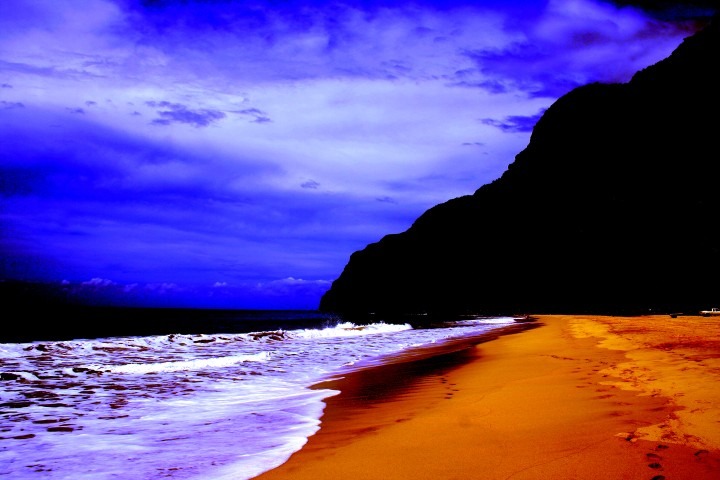
Ironically, I’m not arguing against creative photography; quite the opposite. I have an entire category of images I jokingly call “PhArts.” It’s my own playful name for artistic photographs that intentionally move beyond literal documentation. One of my favorite images was created at Polihale Beach in Hawaii (see featured image for this article). The final result doesn’t perfectly represent reality; it represents something more important. It captures the feeling, the heat, the atmosphere, and the emotional experience of standing there. That’s art, and art has always been allowed—even encouraged—to interpret reality. The key difference is that art doesn’t pretend to be documentary evidence.
Are We Creating Unrealistic Expectations?
This isn’t just about photography; it’s about culture. We’ve already watched social media filters reshape beauty standards, and now AI can reshape reality itself. If every image is polished beyond recognition, if every office looks like a luxury showroom, every employee looks like a stock model, and every family photo is generated, what happens to our expectations of real life? That’s the slippery slope that concerns me. Not because technology is bad, but because trust is fragile.
Trust is based on authenticity. We do find limits occasionally. When advertising crosses the imaginary line between real and fake, consumers push back, leading to rules and laws addressing business advertising, misrepresentation, and false advertising. We have been having these discussions since before anyone ever conceived of mass communication. Consumer protection from being deceived by women figures being “photoshopped” beyond healthy or even realistic possibilities. We now need to discuss this topic again, and we need to do it at breakneck speed. AI is moving and changing at a speed that humans can’t comprehend.
Where are we?
I believe AI is an extraordinary tool—I teach about it and use it every day—but I also believe every tool deserves ethical boundaries. Use AI to brainstorm, enhance, restore, or create amazing art. But if we’re creating synthetic photographs of events, people, businesses, or places that never existed—and presenting them as though they did—I believe we’ve crossed a significant boundary—again. We have been here before, but things are moving much faster now. We need to be clear about where to push back or accept it. I want to know if something is fully AI-created—like the food I put in my body or the information I put in my head. Authenticity is becoming more valuable precisely because it is becoming harder to verify.
What Do You Think?
Where do you draw the line?
- Is replacing a background acceptable?
- Does it matter if an AI-generated image looks realistic?
- Should businesses disclose when an image is synthetic?
- Is there a difference between art and advertising?
- Have we already entered the era of Looker Syndrome?
I’d genuinely like to hear your perspective.
Leave a comment below and join the conversation. I suspect this debate is only just beginning.
Further Reading & Research
If this topic interests you, I encourage you to explore the research for yourself.
AI Adoption in Marketing
- Canva & The Harris Poll. The State of Marketing & AI Report (2026) – Marketing adoption, consumer attitudes, and trust in AI-generated advertising.
AI in Retail Marketing
- Reuters. Zalando Uses AI to Speed Up Marketing Campaigns and Reduce Costs – Case study on AI-generated marketing imagery, production speed, and cost savings.
Artificial Intelligence Research
- Stanford University. AI Index Report – Annual report on AI adoption, business use, governance, and societal trends.
Research on AI Images and Consumer Trust
- International Journal of Research in Marketing – Studies examining how consumers perceive AI-generated imagery in advertising, healthcare, and service industries.
Ethics, Transparency, and Digital Likeness
- Research on consumer trust, disclosure, and the ethical implications of AI-generated imagery, along with ongoing discussions surrounding AI-generated digital likenesses within the entertainment industry.
The goal of this article isn’t to tell you what to think.
It’s to encourage all of us—photographers, artists, marketers, business owners, and consumers—to ask an increasingly important question:
When does enhancing reality become replacing it?
I believe that’s a conversation worth having.
Want to Use AI Responsibly in Your Business?
AI isn’t the problem.
Using it without understanding where it helps—and where it can undermine trust—is.
I work with businesses to develop practical AI policies, marketing strategies, and workflows that help teams use AI effectively while protecting authenticity, customer trust, and brand reputation.
Whether you’re just getting started or already using AI every day, the goal isn’t to avoid AI—it’s to use it wisely.